The "What About the Bass?" Problem
You're forming a band: you've got vocals, guitar, and drums. "Great, now we just need a bassist"—and that's where things get long and difficult.
As I mentioned in the article about drummer shortages, member recruitment site data shows bass has a "chronic shortage" in terms of supply and demand by instrument. It's not quite as dire as drums, but you'll never see a situation like "we posted for guitar and got 5 applications by the next day."
I've been playing in bands since my twenties, and even now in my sixties I'm still searching for members. I've played at various venues—Mandala in Kichijoji, UZU in Fussa—with all kinds of musicians. Blues, Soul, roots music—the music I've made has always relied on the bass line. That's exactly why I've struggled to find bassists, and why I've been so particular about them.
In this article, I'll write honestly from my 30 years of experience about why bassists can't be found and how to actually find them.
The Reality of Bassist Shortages — Looking at the Numbers
First, let me organize the reality of bass recruitment based on my experience and the trends I see in recruitment sites.
| Metric | Bass Situation | Reference: Guitar |
|---|---|---|
| Volume of recruitment posts | High (2nd most after drums) | Lower |
| Volume of applications | Somewhat low | Very high |
| Applications per posting | Feels like 0-2 on average | Feels like 3-8 on average |
| Probability of showing up at studio | About half of applicants | 7-8 out of 10 applicants |
| Retention rate after joining | Somewhat low | Normal |
Pay special attention to "retention rate after joining." Bassists often get poached by other bands or juggle multiple projects, and it's not uncommon for a bassist you finally found to leave after six months because "my other band got busier." It's the same structure as with drummers—the fewer musicians available in a part, the more in-demand they are, and the harder they are to keep in one band.
Why Are Bassists So Scarce? — 5 Reasons

1. The Image Problem: Bass is "Boring"
Guitarists play solos and get applause. Vocalists are the star of the show. Drummers look great on stage. And bassists? "That quiet person in the back"—that's the general public's image.
In reality, bass is the backbone of the band, the key to the groove, the bridge between drums and guitar—it's an incredibly important position. But that magic only resonates with people who "get it." The moments when a middle or high school student thinks "I want to be a bassist!" are far fewer than those who dream of being a guitarist or vocalist.
2. Starting as a Last Resort
When picking an instrument for the school music club, guitar fills up, then drums, then vocals, then keyboards—and then "what's left is bass." A surprising number of people started bass this way. People who began through elimination tend to quit the instrument entirely when the band breaks up.
Of course, some of these people fall in love with bass afterward. But the absolute number of people who started bass because they loved it from the beginning is small, which means the overall pool is structurally insufficient.
3. Overshadowed by Guitar
Bass and guitar look similar. The difference is four strings versus six. But public attention is overwhelmingly on guitar. YouTube view counts, display space in music stores, magazine covers—guitar is favored in everything.
"If I'm going to play a stringed instrument anyway, guitar is cooler." That's the perception. Bass doesn't get the respect it deserves in the world (bassists, you have every right to be frustrated).
4. Playing Solo Doesn't Convey the Appeal
A guitarist can play chords and sing alone. Same with piano. A drummer can enjoy drumming patterns by themselves.
Bass? Playing alone just sounds like "brrm-brrm"—low notes going nowhere. Bass's real pleasure only comes when it locks in with the drummer's kick, when it meshes with the guitarist's chords. You don't truly understand how cool bass is until you're in a band playing it. But many people quit before they get there.
5. Great Bassists Are Too Busy Juggling Multiple Projects
As I wrote in the drummer shortage article, the supply-and-demand imbalance creates juggling. Good bassists constantly get offers. It's common to see bassists playing in 2 or 3 projects, which means even fewer "freelance bassists" are available.
This structure can't be changed. So just searching for a "freelance bassist" won't work. You need to change your approach.
How to Actually Find a Bassist — 5 Solutions

Now for the real solutions. Just posting a recruitment and waiting won't find you a bassist. So what actually works? Here are 5 methods that I've tested over 30 years and proven effective.
Solution 1: Target Guitarists Open to Switching
This has the highest success rate. As I wrote in the article on why some people can't find members, "expanding your search" is key.
There are plenty of guitarists. If you're getting multiple guitar applications that you're turning down—why not ask one of them, "Want to try bass?"
There are big advantages to recruiting a bassist from guitarists:
- They already have the fundamentals down—how to press frets, picking technique
- They understand chords and scales
- If they have band experience, they already grasp ensemble dynamics
- "I can't get into a guitar band" becomes "I'm welcomed as an instant contributor," which feels great
In fact, many world-famous bassists came from guitar backgrounds. Paul McCartney and John Paul Jones both started on guitar.
Solution 2: Invite Complete Beginners to Learn Together
Are you looking for "3+ years bass experience" or "can handle original songs"? Remove those requirements.
With 3 months of serious practice, someone can reach the level to join band rehearsals. Even just playing roots—you can manage that in a month. As I wrote in the guide to beginners joining bands, "you can start a band with zero experience."
If someone says "I'm interested in bass but don't have an instrument," let them touch a rental bass at the practice studio once. That alone can change "maybe" into "let's do it."
As I wrote in the article on band expenses, beginner bass guitars start at 20,000-30,000 yen. Mention that the initial investment is actually lower than guitar.
Solution 3: Scout at Session Events
Jam sessions and open mic nights work for finding bassists too—not just drummers. Bassists who come to sessions are usually people who want to play more.
Session bars around Kichijoji, Shimokitazawa, Shibuya, and Shinjuku attract freelance bassists. Play a session with them, and if the vibe clicks, ask "interested in our band?" There's something in the feeling when your sounds mesh that recruitment site text alone can't convey.
Solution 4: Use SNS and DTM Communities
Plenty of people post "bass cover" videos on YouTube, X (Twitter), and Instagram. Even with a small following, talented people are out there. Sending them a direct message—"interested in a band?"—doesn't usually get a cold reception. Often they're thrilled.
Reach out to people doing drum machine bass programming on DAWs too. Someone who can craft bass lines in their DAW usually has good instincts when they actually pick up the instrument.
Solution 5: Look at Foreign Bassists
As I wrote in the article on foreign musicians finding bandmates in Japan, foreign musicians living in Japan often want to join a band but don't know where to look. Especially bassists from America or Europe who have funk, soul, and R&B grooves in their bones.
The language barrier can be overcome with Membo's translation chat feature. Don't cross someone off the list because "they don't speak Japanese." Music has no borders.
Case Study: "Take My Bass—Will You Play with Us?"

I'll be honest: I'm still looking for a bassist. I haven't found one yet.
I've asked guitarists countless times: "Want to try bass?" Guitarists from recruitment sites, musicians I met at sessions, friends who got excited talking about music. "I think with your sense of rhythm, you'd become a great bassist quickly," I'd tell them.
Once, I actually offered them my bass at home. "Here, take this bass. Just try it out."
What happened? Some people got interested. But nothing stuck. "I prefer guitar after all." "Work got busy." "It's harder than I thought."—the reasons varied.
Still, I keep asking. People who've never played, people who haven't played in years. "Want to try bass?"
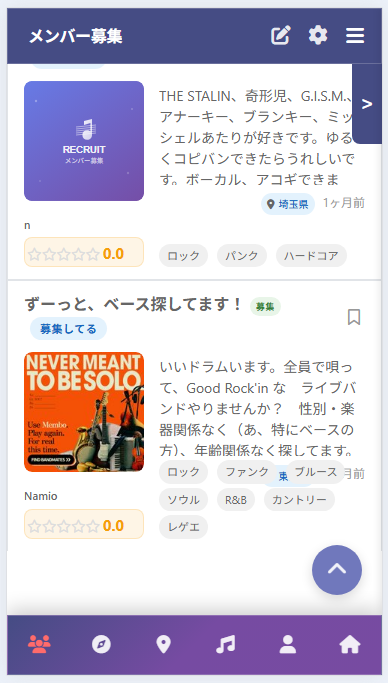
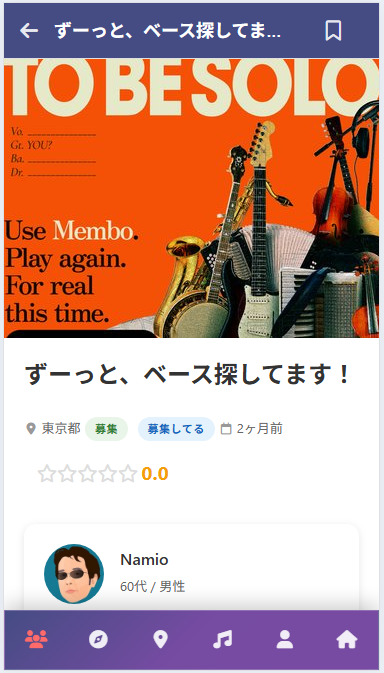
Actually, even now, I'm posting my own recruitment on Membo searching for a bassist. I created this service, and I'm the one using it most desperately. That's how hard bassists are to find. But I'm not giving up at all.
It'll happen someday. I believe that because over 30 years I've learned that meetings come from unexpected places. Like when I found my drummer after searching for three months—at a session bar. When you've given up, they suddenly appear.
What I want to say in this article is: "Don't find a bassist—develop one." And: keep calling until you find them.
How to Write Bass Recruitment Posts That Resonate
Effective recruitment for bass has different elements than other instruments. Here are the things I've found work best:
Always Write "Beginners Welcome, Breaks OK"
With so few bassists, widening the net is essential. "No experience needed. All that matters is loving music"—just this phrase lowers the barrier to applying. People who used to play bass but haven't in years get encouraged by it too.
Always Attach Band Audio
Bassists want to imagine "what bass lines will I be playing?" With a demo, they can think "I could play this." Without it, applicants just feel anxious. Even a smartphone recording from the studio works—just include something.
Show Respect for the Bass in Your Text
"Any bassist will do." "We just need a bass, really." These recruitment posts are actually common. Bassists spot this immediately.
Try this instead: "We believe bass is the core of our band. We're looking for a bassist to build the groove with us." Bassists are drawn to bands that understand their role.
Be Clear About Practice Frequency and Costs
"Twice a month, Saturday afternoons, studio fees split evenly"—just writing this increases applications. Vague posts create anxiety: "Will they want me to practice 3 times a week?" "Will only the leader pay less?" Being clear about band activity costs matters.
Post Multi-Language Recruitment on Membo
Write your recruitment in Japanese and it automatically translates to 8 languages. You'll reach foreign bassists in Japan. With famous cover songs like those in our guide to starting a cover band, you might find someone who says "I know that! I can play it!"—and nationality doesn't matter. The wider you search, the better.
Spreading the Word About Bass — "Boring" Is a Massive Myth

"Bass is boring"—this belief is at the root of the bassist shortage. That's why we musicians need to talk more about how amazing bass is.
Listen to a band without bass. It sounds thin, weak, missing something vital. The moment bass comes in, the sound becomes three-dimensional. When the kick drum and bass root lock together—that low-frequency rumble can't be created by any other instrument.
James Jamerson's Motown bass lines. Jaco Pastorius's "Portrait of Tracy." Flea's funk bass. In Japan, Seiji Kameda's melodic lines. Only people who haven't heard them would call bass "boring."
If you're searching for a bassist, the first step is that you can genuinely talk about how incredible bass is. That's what attracts great bassists.
Summary: Search for Bassists With the Mindset of "Developing" Them
Bassist shortage is a structural problem. Few people start on bass, many quit, and great players are always in demand. This reality won't change easily.
That's exactly why you need to shift your thinking.
- Target guitarists open to switching — Among the surplus of guitarists lies a future bassist
- Widen the doors for beginners — Bass reaches performance-ready in 3 months
- Scout directly at sessions — Choose based on musical chemistry when your sounds mesh
- Approach SNS and DTM communities — Behind those cover videos are potential members
- Look at foreign bassists — Membo broadcasts recruitment in 8 languages
Most importantly: "Don't find a bassist—develop one." They might be inexperienced, transitioning from guitar, or rusty from time away. As long as they have the passion to make music together, find them and grow together. Bands with that resolve attract great bassists.
I'm 60 now and still seeking new bandmates. Giving up on a band because there's no bassist? That would be such a waste.
- Find a bassist on Membo — Filter by "Bass" to see only bassist candidates. Reach foreign musicians with 8-language support
- Sign up free — Post recruitment and apply for free. Create a profile today
- Is there really a drummer shortage? — The actual state of part-by-part recruitment — It's not just bass—here's the recruitment reality by instrument
- 5 traits shared by people who can't find members and solutions — Tips to rethink your search strategy itself
Your band's foundation might be closer than you think. The guitarist beside you at the next session might become your bassist tomorrow.